
Financing Business Expansion: A Plain-Language Guide
Growing a business costs money before it makes money. A second location, new equipment, more staff, or a bigger stock of inventory all need paying for before the extra sales show up. That gap is what expansion financing is for: money that bridges the distance between the plan and the payoff.
This guide explains it in plain words: what lenders look at, the main ways to fund an expansion, and what to have ready before you ask.
What "expansion" usually means
Expansion takes different shapes. A shop opens a second location. A contractor buys another truck and hires a crew. A manufacturer adds a machine that doubles output. A restaurant takes the space next door. Sometimes expansion means buying another business outright.
The shape matters, because the right kind of financing follows what the money is for. Money for a building is different from money for inventory, and money for a slow ramp-up is different from money for a one-time purchase.
What lenders look at
Every lender has its own checklist, but most look at the same five things.
Cash flow. The big question is whether the business brings in enough money, after expenses, to handle a new payment. A lender will look at your recent sales and costs, not just your hopes for the new location. Steady cash flow is what makes a lender comfortable.
Track record. How long have you been in business, and how steady has it been? A business with a few good years behind it is easier to lend to than one that just opened. The lender wants to see that you have run a business through good months and slow ones.
The plan. What exactly is the money for, and how does it pay for itself? A clear, simple plan beats a thick binder. If a second location is expected to cover its own costs within a certain time, say so, and show the numbers behind it.
Your own stake. Lenders usually want the owner to have real money in the expansion too. Putting your own money in shows you believe in the plan, and it lowers the lender's risk.
Credit and paperwork. Your business credit, your personal credit history, and your records all matter. Tax returns, bank statements, and financial statements are the proof behind the plan, so having them organized and up to date helps.

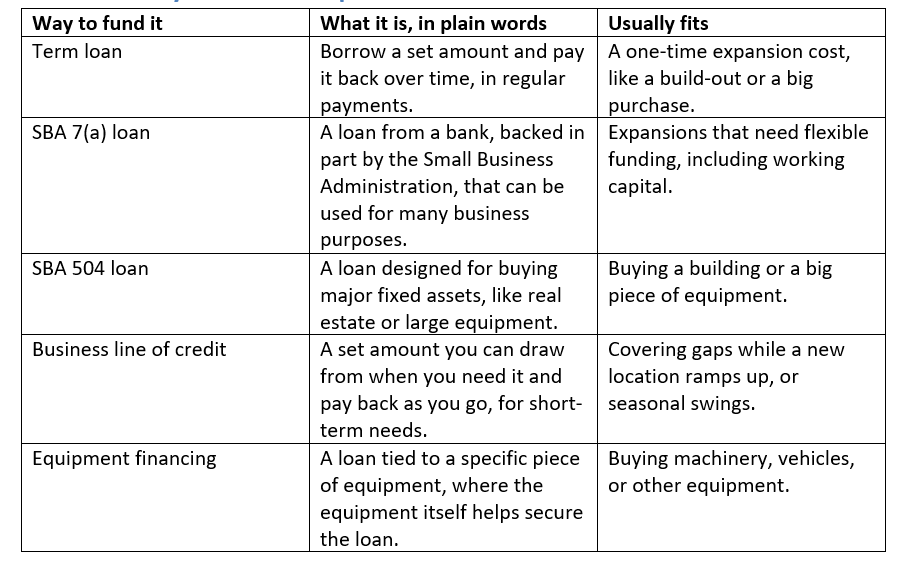
The main ways to fund it, in plain words

Each path has trade-offs in paperwork, timing, and what it can be used for. The right one depends on what you are buying, how fast you need the money, and how your business earns.
A simple example
Say a bakery has done well in one spot for five years and wants to open a second shop across town. The owner knows the new shop will need rent, ovens, and staff for several months before it earns enough to cover itself. That is a typical expansion gap: the money goes out first, and the sales catch up later. The lender will want to see the first shop's cash flow, a simple plan for the second shop, and enough cash set aside to get through the slow first months.
(This is a made-up example, not a real business.)
Costs people forget
New space and new equipment are the obvious costs, but they are rarely the only ones. Plan for hiring and training, extra inventory, marketing for the new location, and the months when the new spot earns less than it costs. Expansion often means the business earns less for a while before it earns more, and a lender will notice if the plan pretends otherwise.
How to get ready
Before you talk to a lender, know your numbers: recent sales, costs, and cash flow, and what the expansion itself is expected to cost. Gather your financial statements, tax returns, and bank statements. Write down, in a page or two, what the money is for and how the expansion pays for itself. And talk to a lender early, before you sign a lease or place an order, so you know what fits and what your business can support.
An expansion can be a strong step when the numbers are honest and the financing fits the plan. If you want to walk through an expansion you have in mind, in plain words and with real numbers, JD Agban Group offers a free 30-minute consultation. Book at https://calendly.com/gagban/financial-home-tour or email george.agban@jdagban.com
Disclaimer: This post is general information, not a promise of approval, a rate, or exact terms. Loan programs and rules change over time — check the current details with your lender.