

Down Payment Options for Homebuyers: How Much Do You Really Need?

George Agban • October 17, 2026

Share this article

One of the most persistent myths in real estate is that you need a 20% cash down payment to buy a home. While putting 20% down offers clear advantages—such as avoiding private mortgage insurance (PMI) - it is far from a requirement for most buyers today.


Depending on your financial profile, eligibility, and loan program, down payment requirements for residential mortgages can range from 0% to 20% or more. Here is a complete breakdown of the down payment options available to homebuyers.

Couple reviewing paperwork at a kitchen table with laptop and small house model

1. Zero-Down Payment Programs (0% Down)

If you qualify, government-backed programs allow you to purchase a home with no money down:

  • VA Loans (0% Down): Available to eligible military service members, veterans, and surviving spouses. VA loans offer competitive interest rates, no down payment requirements, and no monthly mortgage insurance (though a one-time VA funding fee applies).


  • USDA Loans (0% Down): Backed by the U.S. Department of Agriculture, these loans are designed for low- to moderate-income buyers purchasing homes in designated rural and suburban communities.


2. Low Down Payment Options (3% to 3.5% Down)

For buyers who don’t qualify for 0%-down government programs, several low-down payment options make homeownership accessible:


  • Conventional 97 / HomeReady® / Home Possible® (3% Down): Standard conventional loan programs allow first-time homebuyers (and qualifying repeat buyers) to put as little as 3% down. These require a minimum credit score (typically 620+) and private mortgage insurance (PMI) until you reach 20% equity.


  • FHA Loans (3.5% Down): Insured by the Federal Housing Administration, FHA loans are popular among buyers with moderate credit scores (starting at 580 for 3.5% down) or higher debt-to-income ratios. FHA loans require both an upfront and annual Mortgage Insurance Premium (MIP).


3. Traditional Down Payments (10% to 20%+ Down)

Putting down a larger percentage offers distinct financial benefits:

  • 10% Down: Lowers your monthly mortgage payment, reduces mortgage insurance costs, and makes your offer more competitive in multi-offer scenarios.


  • 20% Down (The Benchmark): Putting 20% down on a conventional loan eliminates monthly PMI, immediately lowers your loan balance, and reduces overall interest paid over the life of the loan.


  • Jumbo Loans (10% to 20%+ Down): Used for higher-value homes exceeding conventional loan limits. Lenders often require 10% to 20% down along with higher credit scores and cash reserve requirements.


Down Payment Assistance (DPA) Programs

Many states, counties, and local housing authorities offer Down Payment Assistance (DPA) programs for qualifying buyers. DPA options include:

  • Grants: Funds that do not need to be repaid.


  • Forgivable Second Loans: Second mortgages forgiven after living in the home for a set period (e.g., 3 to 5 years).


  • Deferred Loans: Second mortgages repaid when you sell, refinance, or pay off the primary mortgage.


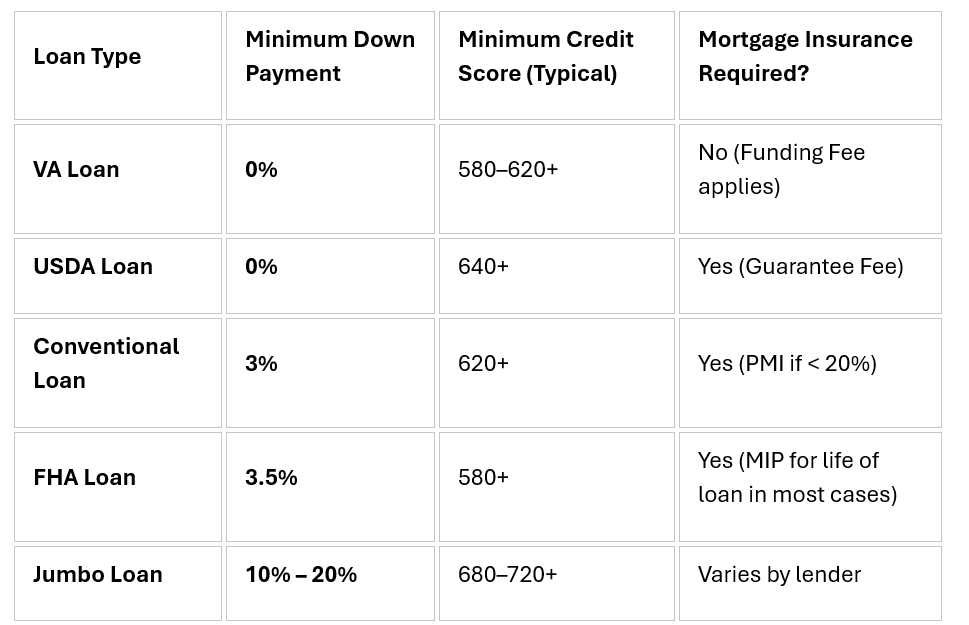
Down Payment Comparison Matrix

Table comparing loan types, minimum down payment, credit score, and mortgage insurance requirements.

Tips for Preparing Your Down Payment


  1. Audit Your Savings & Sources: Down payment funds can come from personal savings, investments, approved gift funds from relatives, or employer housing assistance.
  2. Remember Closing Costs: In addition to your down payment, budget 2% to 5% of the purchase price for closing costs (appraisal, title fees, escrow setup, prepaid insurance).
  3. Get Pre-Approved Early: Working with a licensed loan advisor helps determine which down payment program best fits your budget and homeownership goals.


👉 Schedule a Free Consultation with JD Agban Group today to review your homebuying budget, explore competitive residential mortgage options, and receive a personalized evaluation from our loan advisory team.


Disclaimer: This publication is provided for educational and informational purposes only and does not constitute financial, legal, or mortgage advice. Loan options, down payment minimums, interest rates, and approval requirements vary based on program eligibility, credit score, asset documentation, and lender underwriting criteria.

Recent Posts

Model home, commercial building, and storefront beside financing charts and a calculator
By George Agban • October 12, 2026
Learn how lenders use DTI, DSCR, and cash flow to assess home mortgages, commercial real estate loans, and business financing.

Two people review architectural plans in a modern office overlooking a city skyline.
By George Agban • September 29, 2026
Explore commercial real estate loan options, lender requirements, and key metrics like DSCR and LTV. A practical guide for investors and business owners.

Three people reviewing documents with an agent at a table, with a small house model in front of them
By George Agban • September 23, 2026
What are closing costs, and how much should you budget? Learn about common fees, seller credits, and the documents to review before closing on a home.

Two people reviewing paperwork at a desk in a bright home office
By George Agban • September 10, 2026
Learn how lower credit affects loan approval and explore mortgage and business financing options based on income, cash flow, equity, and reserves.

Tall office buildings with a brown brick facade, blue glass tower, and white stepped skyscraper against a clear sky
By George Agban • August 26, 2026
Should you buy or lease commercial property? Compare costs, flexibility, equity, tax considerations, and financing options to make the right move for your business.

Person in a blue shirt holding several credit cards against a dark background
By George Agban • August 19, 2026
Learn how business credit scores work, why they matter for loans and financing, and how to build stronger business credit for your company.

Graphic about 10 common mortgage mistakes with a house model, keys, and a document on a desk.
August 11, 2026
Learn 10 common mortgage mistakes homebuyers should avoid, from budgeting and credit changes to closing costs, insurance, and choosing the right lender.

Luxury finance desk with calculator, charts, gold bars, model house, and city skyline at sunset
By George Agban • July 14, 2026
Learn the 4 Cs of lending—Character, Capacity, Capital, and Collateral—and discover what banks evaluate before approving mortgages and business loans.

Team collaborating around a desk with charts, laptop, and documents during a business meeting
June 25, 2026
Line of Credit vs. Term Loan: Learn which financing option best supports your business cash flow, growth goals, and long-term success in Texas.

Texas finance ad: financing a home, commercial property, or business, with three client panels and city skyline.
June 15, 2026
Explore home loans, commercial real estate financing, SBA loans, and business funding options in Texas with expert guidance from JD Agban Group.