
Closing Costs Explained: What Every Homebuyer Needs to Know

George Agban • September 23, 2026

Share this article

Closing Costs Explained:

 What Every Homebuyer Needs to Know

When budgeting for a new home, most buyers focus on saving for the down payment. However, another crucial expense to plan for before reaching the closing table is closing costs.

Understanding what closing costs include and how to estimate them ensures you won't encounter unexpected surprises when it comes time to finalize your home purchase.

What Are Closing Costs?

Closing costs are the processing, administrative, and third-party fees required to finalize your mortgage and officially transfer property ownership. These expenses cover services provided by lenders, title companies, appraisers, real estate attorneys, and local government authorities.

How Much Are Closing Costs Typically?

As a general rule of thumb, closing costs typically average between 2% and 5% of the home’s purchase price.

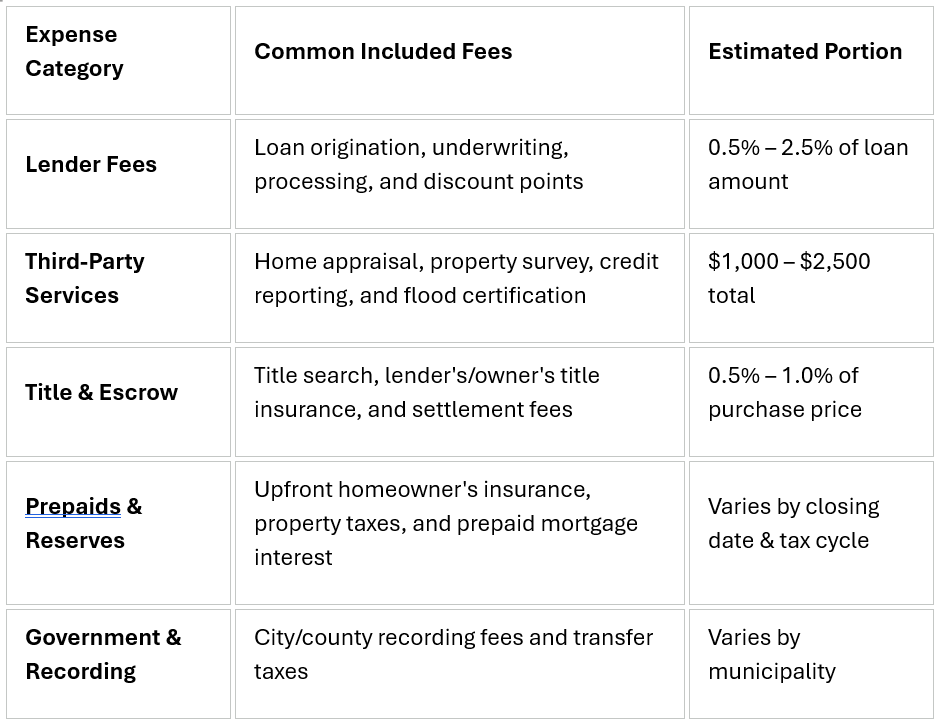
Table listing common home-buying expenses and estimated portions for lender fees, services, title, repairs, and recording.

Estimates provided below are general industry guidelines. Actual costs vary significantly depending on loan size, loan type, property location, and specific lender fees.

For official consumer guidance on mortgage disclosures and fee breakdowns, visit the Consumer Financial Protection Bureau (CFPB).

Please Note: Program guidelines, closing cost estimates, and lender fees are subject to change without notice and vary based on individual financial profiles, property types, and market conditions.

Frequently Asked Questions About Closing Costs


1. Can closing costs be negotiated or reduced?

Yes. Certain third-party services—such as title insurance providers and home inspections—can be shopped around for better rates. You can also compare Loan Estimates from different mortgage lenders to identify competitive origination and processing fees.

2. Can the seller pay my closing costs?

In many transactions, sellers can offer seller concessions to cover a portion of your closing costs. However, government and conventional loan programs set limits on seller contributions:


  • FHA Loans: Seller concessions are generally capped at 6% of the purchase price (see HUD FHA Guidelines).


  • Conventional Loans: Limits range between 3% and 9% depending on your down payment percentage.


3. Can I roll closing costs into my mortgage?

Rolling closing costs into the mortgage principal is generally available through specific refinancing programs or government-backed purchases, but standard conventional purchase loans usually require closing costs to be paid in cash at closing.


4. How to Prepare for Your Closing Day

  1. Review Your Loan Estimate: Received within three business days of applying for a loan, this document outlines your estimated closing costs.
  2. Compare Your Closing Disclosure (CD): Received at least three business days before closing, the Closing Disclosure details your final itemized fees and exact cash-to-close requirements.
  3. Audit for Unnecessary Fee Changes: Compare the Closing Disclosure against your original Loan Estimate to ensure fees have not increased beyond allowed tolerance thresholds.


Receive a Personalized Cash-to-Close Evaluation

Every homebuying journey is unique, and getting an exact picture of your required down payment and closing costs requires a detailed look at your specific scenario.


At JD Agban Group, we serve as financial educators first, walking you through complete line-item breakdowns so you know exactly what to expect on closing day.


👉 Schedule a Free Consultation with JD Agban Group today to review your homebuying budget, explore competitive residential mortgage options, and receive a personalized evaluation from our loan advisory team.

Recent Posts

Two people reviewing paperwork at a desk in a bright home office
By George Agban • September 10, 2026
Learn how lower credit affects loan approval and explore mortgage and business financing options based on income, cash flow, equity, and reserves.

Tall office buildings with a brown brick facade, blue glass tower, and white stepped skyscraper against a clear sky
By George Agban • August 26, 2026
Should you buy or lease commercial property? Compare costs, flexibility, equity, tax considerations, and financing options to make the right move for your business.

Person in a blue shirt holding several credit cards against a dark background
By George Agban • August 19, 2026
Learn how business credit scores work, why they matter for loans and financing, and how to build stronger business credit for your company.
Graphic about 10 common mortgage mistakes with a house model, keys, and a document on a desk.
August 11, 2026
Learn 10 common mortgage mistakes homebuyers should avoid, from budgeting and credit changes to closing costs, insurance, and choosing the right lender.

Luxury finance desk with calculator, charts, gold bars, model house, and city skyline at sunset
By George Agban • July 14, 2026
Learn the 4 Cs of lending—Character, Capacity, Capital, and Collateral—and discover what banks evaluate before approving mortgages and business loans.

Team collaborating around a desk with charts, laptop, and documents during a business meeting
June 25, 2026
Line of Credit vs. Term Loan: Learn which financing option best supports your business cash flow, growth goals, and long-term success in Texas.

Texas finance ad: financing a home, commercial property, or business, with three client panels and city skyline.
June 15, 2026
Explore home loans, commercial real estate financing, SBA loans, and business funding options in Texas with expert guidance from JD Agban Group.